How to Make Money From Your Website With Google AdSense
How Google AdSense works, what RPM and CPC mean, how to get your site approved, which pages and policies matter, and why earnings take months to grow.
Published 6 min read
In this article
Google AdSense is a free program that shows ads on your website and pays you a share of what advertisers spend. You sign up with a Google account, add a small piece of code to your site, and once Google reviews and approves the site, ads appear automatically and you earn from ad views and clicks.
In short: build a site with genuinely useful original content, add privacy, about and contact pages, apply to AdSense, follow the policies (never click your own ads), and expect earnings to start small and grow slowly, over months, as your traffic grows.
How AdSense works
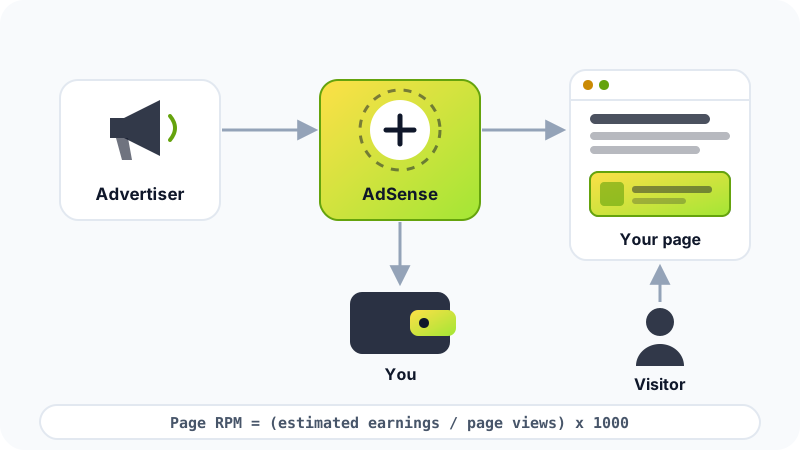
AdSense connects three parties:
- Advertisers create campaigns in Google Ads and bid to reach certain audiences.
- You, the publisher, give Google space on your pages by adding the AdSense code.
- Google runs an automatic auction when a page loads, picks ads that fit the page and the visitor, and shares the revenue with you.
You don't negotiate with advertisers or choose each ad yourself. You can, however, block some ad categories or specific advertisers' websites from your account settings if they don't suit your audience.
RPM, CPC and impressions in plain words
Your AdSense reports use a few terms again and again:
- Impression: an ad was shown to a visitor. Some ads earn from impressions, not only clicks.
- CPC (cost per click): what an advertiser pays when someone clicks their ad. It varies widely by topic, country and season.
- Page RPM (revenue per mille): your estimated earnings for every 1,000 page views. It rolls impressions and clicks into one number, which makes it the most useful metric for comparing pages or months.
Page RPM = (estimated earnings / page views) x 1000

Illustrative example only, not a typical figure:
3 in earnings from 1,500 page views
RPM = (3 / 1500) x 1000 = 2
Many things move your RPM: the topic of your site (some subjects attract more advertisers), where your visitors live, the device they use, the time of year, how and where ads are placed, and how fast and easy your pages are to use. That's why two sites with the same traffic can earn very different amounts.
Before you apply: eligibility basics
- Age: you must be at least 18 to have your own AdSense account.
- A site you control: you need to own the site and be able to add code to its pages, usually in the
<head>section. - Original content: your own articles, tools or media, not copied or scraped from other sites.
- A finished site: no "coming soon" pages, broken links or empty categories.
- Accurate details: the name and address on your account should match your identity documents, because Google verifies them before paying.
- One account is enough: you can add several sites to the same account, so there's no need to open more than one.
If you haven't built your site yet, start with our guide on how to build your own website from scratch.
Pages your site should have
- Privacy policy (required): AdSense requires you to disclose that third parties, including Google, use cookies to serve ads based on visits to your site and other sites, and to tell visitors how they can opt out of personalised ads.
- About page: who runs the site and why. It isn't a formal requirement, but it builds trust with visitors and reviewers.
- Contact page: an email address or a contact form so readers can reach you.
- Clear navigation: a menu, categories and working internal links, so both people and reviewers can find the content easily.
If you have visitors from the European Economic Area, the UK or Switzerland, Google requires a consent message from a certified consent management platform. AdSense includes its own consent message tool that you can turn on from your account.
Content that gets approved
A common reason for rejection is content Google considers low value. To avoid it:
- Write articles that fully answer real questions people search for.
- Keep a clear focus, so the site has an obvious topic and audience.
- Add your own experience, examples and screenshots rather than repeating what's already everywhere.
- Fix spelling, formatting and broken pages.
- If you use AI tools, edit and fact-check the output and add your own knowledge. Publishing large amounts of unedited generated text risks being treated as low-value content.
There is no official minimum number of articles. Ten thorough, original articles on a clear topic are more convincing than a hundred thin ones.
How to apply, step by step
- Go to
adsense.google.comand sign in with your Google account. - Enter your site's address and your country, then review and accept the terms yourself.
- Copy the site code AdSense gives you and paste it into the
<head>of every page. It looks like this, with your own publisher ID:
<script async src="https://pagead2.googlesyndication.com/pagead/js/adsbygoogle.js?client=ca-pub-XXXXXXXXXXXXXXXX"
     crossorigin="anonymous"></script>
- Create a file called
ads.txtat the root of your domain (for exampleyoursite.com/ads.txt) and paste in the line AdSense shows you. It usually looks like this:
google.com, pub-XXXXXXXXXXXXXXXX, DIRECT, f08c47fec0942fa0
- Request a review in AdSense and wait. Keep publishing good content in the meantime.
- After approval, turn on Auto ads (Google picks the placements) or create ad units and place them yourself.
- Complete your payment profile: identity and address verification (often a PIN sent by post), any tax information Google asks for, and a payment method.
Payments are made monthly once your balance reaches the payment threshold, which is set in your currency (100 US dollars for accounts paid in dollars).
Policies you must respect
Breaking AdSense policies can lead to deducted earnings, limited ad serving or a disabled account. The most important rules:
- Never click your own ads, even to "test" them. Use the preview tools instead.
- Don't ask anyone to click, and don't use phrases like "click the ads to support us".
- No artificial traffic: no bots, traffic exchanges, or cheap paid traffic from unknown sources.
- Don't disguise ads: don't make them look like menus, download buttons or part of your content.
- Keep content within the policies: no pirated material, adult content, content that promotes violence or hate, or content that misleads visitors.
Also avoid anyone selling "approved AdSense accounts" or guaranteed approval tricks. Buying or selling accounts breaks the terms, and many of these offers are scams. Our guide on how to spot "make money online" scams explains the warning signs.
Why earnings take time, and what to expect
AdSense earnings depend mostly on traffic, and a new site often takes months before search engines send it steady visitors. Early on, it's normal to see very small amounts for a long time. Results vary widely from one site to another, so treat any income numbers you see online as someone else's situation, not a forecast for yours.
What helps over the long run: publishing consistently, updating older articles, improving page speed, and building an audience that comes back. Many site owners also combine ads with other income, such as selling digital products, so that the site doesn't depend on a single source.
Frequently asked questions
How many visitors or articles do I need before applying to AdSense?
Google doesn't publish a minimum number of visitors or articles. What matters is original, useful content, clear navigation and following the policies. In practice, though, earnings stay very small until the site has steady traffic.
How long does AdSense approval take?
The review usually takes from a few days to a few weeks. Keep the AdSense code on your site while it's under review. If you're rejected, fix the issues Google lists and request another review.
Can I use AdSense on a free blog?
Some hosted platforms, such as Blogger, have built-in AdSense integration. On other sites you need to be able to add code to your pages. A custom domain gives you more control and usually looks more trustworthy to visitors.
When and how does AdSense pay?
Earnings are finalised monthly, and you're paid once your balance passes the payment threshold and your identity, address and payment details are verified. The payment methods available, such as bank transfer, depend on your country.
Can I ask friends to click my ads to support me?
No. Asking anyone to click, clicking your own ads, or using bots or paid traffic schemes all count as invalid traffic. Google can withhold earnings and disable the account, so let clicks happen naturally.
Related tutorials
Earning online
AI Skills Freelancers Can Sell: 6 Services and How to Deliver Them Well
Six AI-assisted services freelancers can offer, from writing and images to chatbots and automation, plus how to be honest with clients and check quality.
· 6 min read
Earning online
How to Spot 'Make Money Online' Scams and Protect Yourself
Learn the warning signs of online money scams, from upfront fees and guaranteed returns to fake jobs and task apps, and how to check offers and report fraud.
· 6 min read

Earning online
How to Start Freelancing From Zero: A Practical Beginner's Guide
Start freelancing with no experience: pick a skill, build a small portfolio, use platforms like Upwork, Fiverr or Mostaql, set your prices and get paid safely.
· 7 min read